Executive Summary
This paper introduces Environmental Infrastructure Engineering as an emerging discipline that reframes transportation assets as active generators of environmental value. Rather than optimising only for reduced emissions, vehicles are engineered to capture carbon, purify air, harvest water and produce auditable environmental intelligence during normal operation. Railways are proposed as the first viable platform for this approach given their standardised fleets, predictable duty cycles and continuous interaction with ambient air.
From transportation to environmental infrastructure
For over a century, vehicles have been engineered primarily around movement. Yet every vehicle in operation interacts continuously with large volumes of ambient air, thermal energy and atmospheric moisture — interactions that conventional engineering treats as incidental rather than as a resource. Environmental Infrastructure Engineering treats these interactions as a first-class design objective alongside propulsion and passenger comfort.
Why railways first
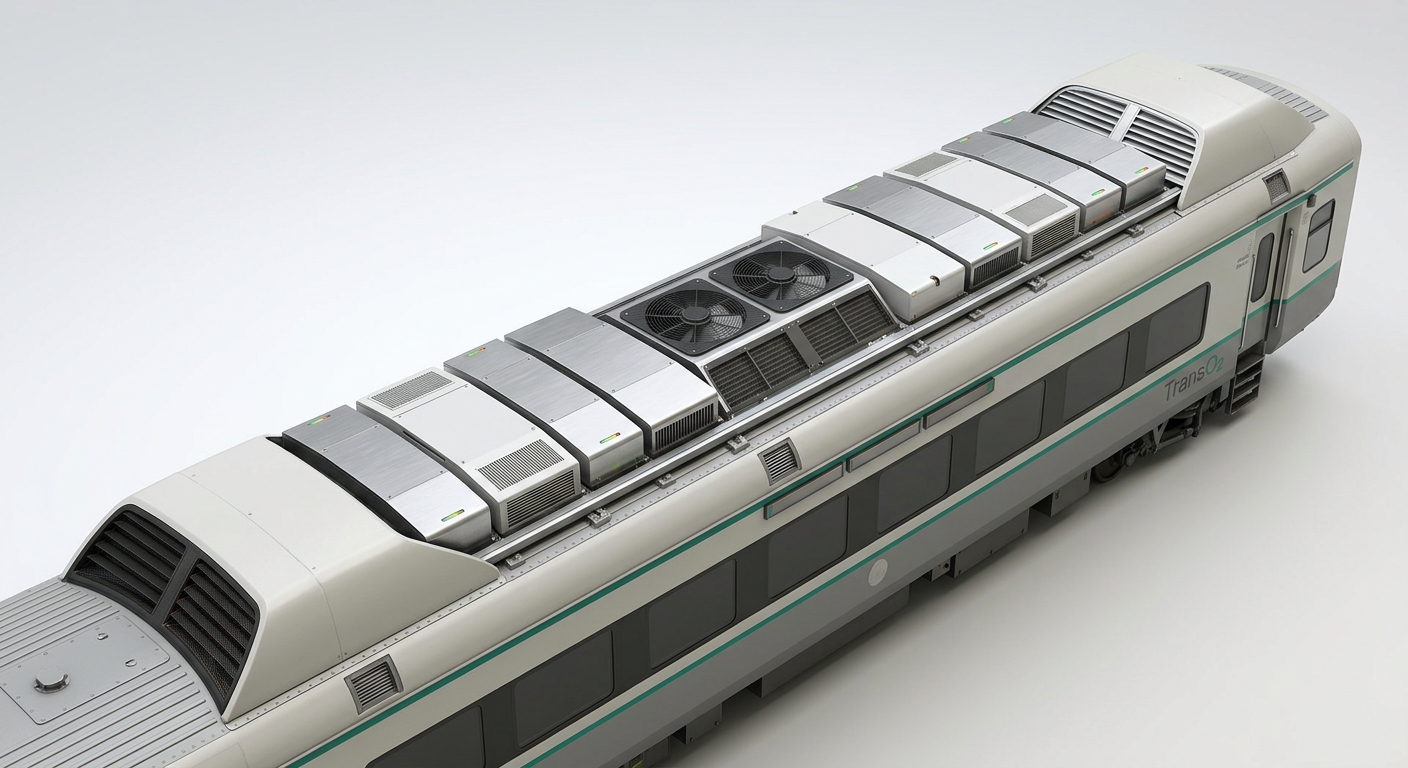
Railways combine large, standardised fleets, predictable duty cycles, ample rooftop area and continuous interaction with air and moisture, making them a natural first platform for integrated environmental systems. A single rooftop-integrated module design can, in principle, be replicated across thousands of coaches with consistent performance characteristics.
This publication describes conceptual frameworks and proposed architectures. Where quantitative figures appear, they are engineering projections intended for planning and are subject to experimental validation.
A modular systems approach
Rather than a single monolithic system, the proposed architecture is built from interoperable modules — air management, environmental conditioning, carbon capture, thermal management, resource management and environmental intelligence — coordinated by a central control and analytics layer. This modularity is intended to allow phased validation, incremental certification and future adaptation to other mobility and industrial contexts.
Glossary
References
References point to established engineering disciplines and public frameworks, not fabricated citations.
- IPCC frameworks on transport-sector decarbonisation
- India's Carbon Credit Trading Scheme (CCTS)
- Indian Railways' stated Net-Zero 2030 ambition
- General principles of systems engineering (INCOSE)
Suggested Citation
TransO2 Engineering Team (2025). Environmental Infrastructure Engineering: Defining a New Discipline. TRN-001, v1.0.
About TransO2
TransO2 is an Environmental Infrastructure Technology company developing integrated engineering concepts that reimagine transportation assets as intelligent environmental platforms. Through systems engineering, sustainability, digital technologies, and modular design, TransO2 explores new approaches to environmental value creation across mobility and infrastructure.