The environmental engineering platform
A stunning, interactive engineering platform integrated into the vehicle architecture — manufacturable, modular and intelligent.
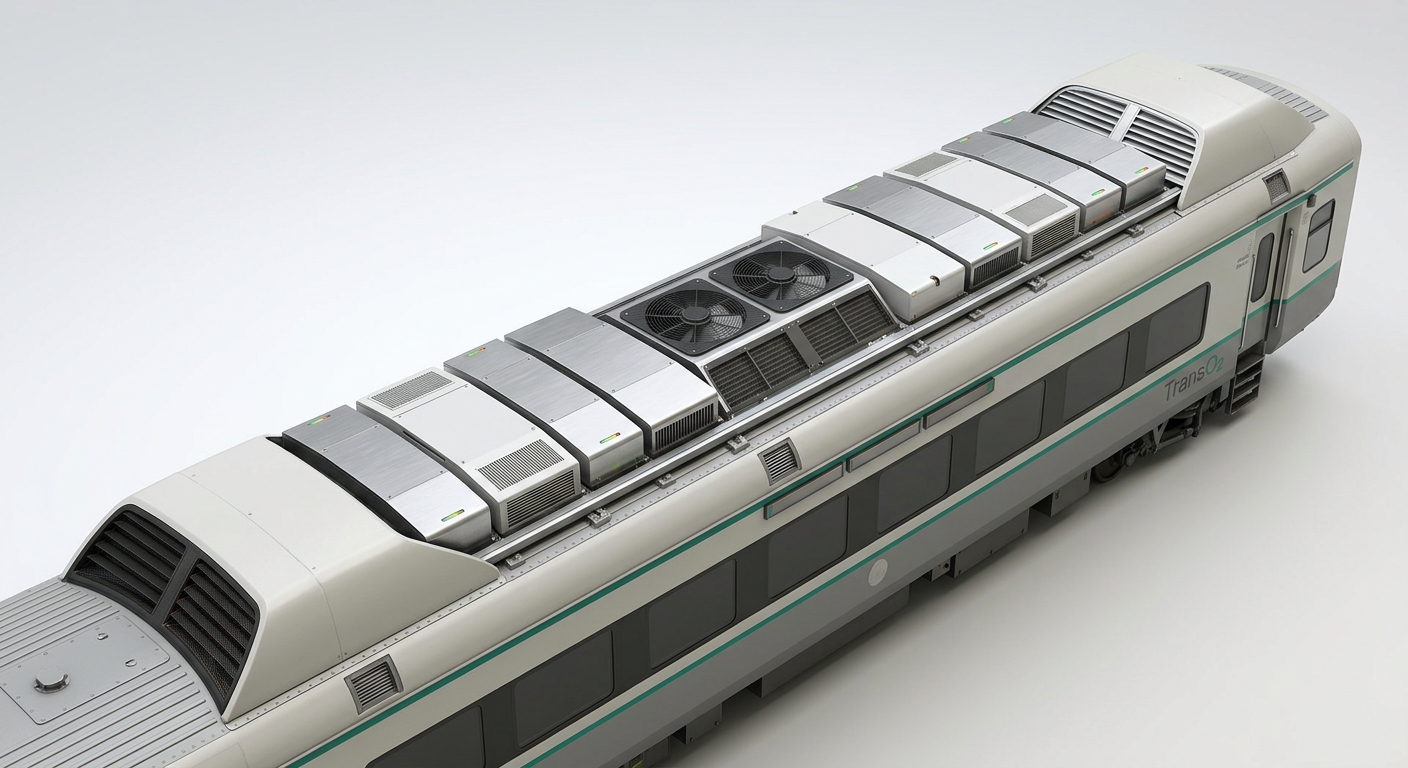
Explore the 11 modules
Select a sub-system to see its role and operating principle.
Air Management System
Intake, filtration and distribution of clean air across the vehicle envelope.
Concept renders and General Arrangement drawings of the Integrated Environmental Resource Platform (IERP) — a rooftop fitment for the LHB coach within a ~460 mm aerodynamic, RDSO-compliant envelope. Illustrative and subject to detailed engineering.
Real numbers, per coach
The platform is sized against concrete, physically grounded design assumptions for every coach it is fitted to.
Captured carbon becomes a resource
Instead of being released, captured CO₂ is put to work inside the coach — for thermal management and for a clean, fast fire-suppression network.
Captured, stored, reused
100 kg of CO₂ is captured per coach per trip and stored (≈ five 20 kg cylinders) — extracted continuously from cabin and processed air, then offloaded at depot for utilisation.
CO₂ thermal loop (R744)
Captured CO₂ becomes the working fluid in a closed loop across the coach — efficient cooling in summer and heat-pump heating in winter, cutting HVAC energy by ~25%.
CO₂ fire-safety network
A CO₂ tubing-and-sensor network is routed to fire-prone zones — electrical panels, pantry and brake systems — enabling rapid, residue-free CO₂ fire suppression for safer coaches.
Continuous air renewal
~5,000 m³/hour of air is purified per coach while ~1,000 m³/hour of fresh air is introduced — non-stop, throughout the journey.

A closed environmental loop
Capture → thermal utilisation (R744) → fire-safety network → managed storage → depot offload.
From sensor to insight
Edge AI, sensor fusion and a cloud platform combine to create a living environmental model of every vehicle in the fleet.
Edge AI
On-board inference filters and contextualises environmental data in real time.
Sensor Fusion
Distributed sensors merge into a coherent environmental picture per vehicle.
Cloud Platform
Secure ingestion and storage of validated environmental telemetry.
Environmental Digital Twin
A living model of every vehicle's environmental performance.
Fleet Intelligence
Network-wide visibility across every deployed asset.
Predictive Analytics
Anticipate servicing needs and optimise capture efficiency.
Environmental Dashboard
A single pane of glass for environmental value and ESG.
Remote Monitoring
Continuous oversight of distributed environmental infrastructure.
From concept to global deployment
Concept
Category definition and environmental value thesis.
Engineering
Modular architecture and system engineering.
Prototype
Rooftop module prototype and bench validation.
Validation
Performance validation against capture and safety targets.
Pilot
On-network pilot with real operational data.
Commercialization
Manufacturable product and depot service model.
Scale
Fleet-scale deployment and localisation.
Global Deployment
Expansion across mobility and industrial infrastructure.